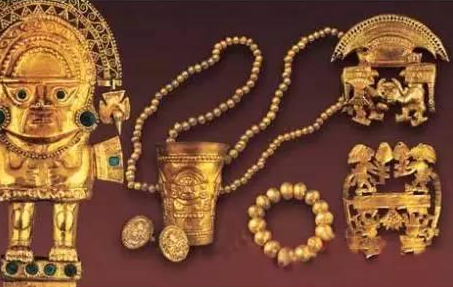
When you think of South America, you might picture the lush Amazon rainforest, the towering Andes Mountains, or the mysterious ruins of Machu Picchu. But behind these magnificent sights lies an astonishing legacy of civilization : the gold and silver artifacts of the Incas .
These gleaming metalworks are not just symbols of wealth, but also expressions of religious belief, social class, and craftsmanship. Spanning centuries of history, they carry the memory of a lost civilization, allowing modern people to still experience the splendor and wisdom of the Inca Empire.
The Brilliant Craftsmanship of the Golden Empire
The Inca Empire (c. 1438–1533) was called the “Golden Empire” not only because they controlled abundant gold and silver resources but also because they developed the art of gold and silver to perfection.
Inca gold and silver artifacts include:
Religious sacrificial supplies : altar decorations, offering containers, statue decorations
Royal ornaments : necklaces, brooches, headdresses, belts
Everyday objects : drinking utensils, tableware, and even some daily necessities are inlaid with gold and silver decorations
These gold and silver objects, designed with meticulous attention to proportion and symmetry, often feature geometric motifs, animals, sacred symbols such as the sun god, eagles, or leopards. They convey both religious significance and social status. Artisans blend metal hammering, inlaying, welding, and engraving techniques to create each piece of exquisite art.
Process flow from mining to smelting
Imagine how hard it was to mine gold and silver in the Andean highlands. The Incas developed mines and water systems to bring the ore up, refine it, and forge it.
The technology they use is amazing:
Fire refining : heating ore with charcoal to separate the metals
Hammering and rolling : beating metal into thin sheets for use in making ornaments or covering statues
Alloys and inlays : enhancing beauty and symbolism by mixing different metals or inlaying gemstones
These techniques not only reflect the skill level of the artisans, but also reflect the high level of division of labor and scientific wisdom in Inca society. Every piece of gold and silverware is the result of the hard work of the artisans and the use of natural resources.
Religious and social symbols
In the Inca civilization, gold and silver are not only wealth, but also sacred symbols.
Symbol of the Sun God : Gold was considered a symbol of the Sun God and therefore played an important role in sacrifices and temple decorations.
A symbol of social status : only members of the royal family and the nobility were entitled to wear certain exquisite gold and silver jewelry.
Rituals and sacrifices : Gold and silver objects were used in religious ceremonies, for sacrifices, celebrations, or to symbolize state power.
It can be said that the Inca’s gold and silver wares are not only beautiful, but also a bridge connecting humans and gods, power and faith.
A legend of loss and discovery
With the invasion of Spanish colonists, the Inca Empire quickly collapsed, and its gold and silver wares were plundered on a large scale. A large amount of precious gold and silver was melted down or shipped to Europe, severely damaging the cultural heritage.
However, some gold and silver artifacts have been found deep in the plateau, in ruins and tombs, and these surviving works of art have become important research objects of modern archaeology.
Since the 20th century, archaeologists have unearthed Inca gold and silver artifacts at sites like Machu Picchu, Sacsayhuamán, and Ollantaytambo, revealing ancient Inca craftsmanship, religion, and social structure.
Each unearthed artifact represents a rebirth of Inca culture, offering a glimpse into the splendor of a lost civilization.
New discoveries from modern research
With the development of science and technology, the study of Inca gold and silver artifacts no longer relies solely on traditional archaeological methods. Modern scholars use:
X-ray fluorescence analysis : determining gold and silver composition and processing
3D scanning and digital modeling : Reconstructing detailed patterns and wearing styles
Isotope analysis : tracing metal origins and understanding mining and trade networks
Through these technologies, researchers have discovered that Inca gold and silver wares are not only exquisitely crafted, but also reflect a complex economic system and social organization: from ore collection, smelting, processing to sacrificial use, each link has a specialized division of labor, showing the highly developed civilization structure of the Inca Empire.

Cultural and artistic value
The value of Inca gold and silver artifacts goes far beyond the artistic level. They also have profound cultural and educational significance:
Witnesses of history
Gold and silver artifacts record the Inca people’s religious beliefs, political power, and social life, allowing us to understand the ancient civilization more intuitively.
Textbook of craft aesthetics
Each piece of gold and silverware is a model of craftsmanship, inspiring modern jewelry design and handicraft creation.
Civilization
Has been lost, the aesthetic and symbolic meaning of gold and silver wares still influence people today, allowing us to resonate with beauty, faith and history.
Museums and modern exhibitions
Today, Inca gold and silver artifacts are mainly collected in major museums around the world, such as the National Museum of Peru, the British Museum in London and the Metropolitan Museum of Art in New York.
Modern exhibitions not only showcase the artifacts themselves but also allow viewers to understand their religious significance, craftsmanship, and historical context through digital interactions, video explanations, and simulated wearing experiences.
Entering the exhibition hall, you’re not just viewing gold and silver artifacts; it’s like engaging in a timeless dialogue with the artisans, priests, and royal families of millennia ago.
Summary : The charm of flash memory
Inca gold and silver artifacts are the shining memories of a lost civilization.
They carry religious beliefs, social hierarchy, craftsmanship, and historical wisdom, and they still shine brightly across millennia.
From the highlands of the Andes to the display cases of modern museums, every piece of gold and silver tells the story of the splendor of empire and the wisdom of craftsmen .
They remind us that the glory of civilization lies not only in magnificent architecture but also in exquisite handicrafts .
Next time you have the chance to visit a museum, take a closer look at the Inca gold and silver artifacts and feel the history, beliefs, and cultural charm behind their glitter.
Each piece tells us: lost civilizations are never truly gone; they are just waiting to be understood and passed on.




