The Engineering Brilliance of Ancient Greek Architecture
The legacy of ancient Greek architecture extends far beyond the aesthetic appeal of marble columns and grand temples. It represents a profound synthesis of mathematics, physics, environmental psychology, and religious devotion. For centuries, modern scholars have attempted to decode the precise methodologies used by ancient builders to achieve structural perfection without the aid of contemporary technology. From the acoustic mastery found in the great theaters to the deliberate manipulation of natural light within sacred sanctuaries, the Greeks engineered spaces that actively shaped human experience.
Recent archaeological excavations, combined with advanced physical modeling, have revealed that these structures were not merely built to house deities or entertain the masses; they were highly sophisticated instruments. The integration of landscape, material science, and spatial geometry allowed ancient architects to create environments that amplified sound, controlled illumination, and provided impenetrable defense systems. Understanding these mechanisms requires a multidisciplinary approach, blending architectural archaeology with modern physics to fully appreciate the genius of antiquity.
The Intersection of Form and Function
In classical Greek design, form never existed independently of function. Every architectural element, from the fluting on a Doric column to the curvature of a theater’s seating arrangement, served a specific, calculable purpose. This holistic approach to building ensured that structures like the Parthenon and the Theater of Epidaurus performed flawlessly in their intended roles, whether that was inducing religious awe or projecting a human voice across a massive open-air venue.
- Material Selection: The deliberate use of specific local stones, such as porous limestone and Pentelic marble, played a crucial role in both the acoustic and reflective properties of the structures.
- Topographical Integration: Buildings were rarely imposed upon the landscape; instead, they were carved into and harmonized with the natural topography to enhance structural stability and sensory impact.
- Mathematical Proportions: The application of the Golden Ratio and advanced geometry ensured not only visual harmony but also optimal load distribution and spatial dynamics.

Acoustic Miracles: The Science Behind Greek Theaters
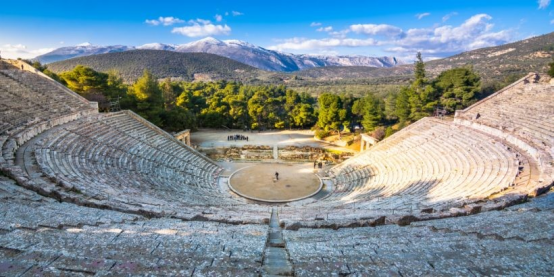
Perhaps one of the most enduring mysteries of the ancient world is the flawless acoustic performance of Greek amphitheaters, most notably the Theater of Epidaurus. For decades, the ability of an audience member seated in the highest tier—nearly 60 meters away from the stage—to hear an unamplified whisper or the strike of a match has baffled scientists. Modern acoustic physics has finally provided a comprehensive explanation, revealing that the “miracle” is actually a highly advanced application of sound wave manipulation.
The secret lies in the precise arrangement and material composition of the stepped seating. The ancient Greeks intuitively understood the principles of acoustic impedance and wave diffraction. By constructing the seating banks at specific angles and utilizing porous limestone, they created a massive, passive acoustic filter. This architectural choice effectively stripped away low-frequency background noise—such as the rustling of trees or the murmur of the crowd—while amplifying the high-frequency sounds of the actors’ voices.
The Corrugated Surface Effect
The geometric structure of the theater acts as a sophisticated sound-filtering system. The rows of limestone seats form a corrugated surface that perfectly matches the wavelength of low-frequency sounds. When these sound waves hit the steps, they are trapped and dampened. Conversely, the high-frequency sounds, which carry the critical consonants of human speech, are reflected and projected upward toward the audience.
This phenomenon, known in modern physics as acoustic diffraction grating, demonstrates that the builders possessed an empirical understanding of sound propagation. Furthermore, the semi-circular design of the orchestra (the performance space) allowed sound to radiate outward in a uniform pattern, preventing the echoes and reverberations that plague modern enclosed auditoriums. The result is an auditory experience of unparalleled clarity, achieved entirely through structural design.

Decoding the Secret Gate to the Acropolis of Athens
While the monumental Propylaia served as the grand, ceremonial entrance to the Acropolis of Athens, recent archaeological surveys have shed light on a lesser-known, highly fortified secret gate. This concealed entrance was not meant for the grand processions of the Panathenaic Festival but was instead a critical component of the citadel’s military defense and emergency logistics. The discovery and subsequent analysis of this hidden portal offer a fascinating glimpse into the strategic mindset of ancient Athenian military engineers.
Located strategically along the steep, craggy slopes of the Acropolis rock, this secret gate provided a covert means of ingress and egress during times of siege. It allowed defenders to launch surprise counterattacks, receive clandestine messages, and access vital water supplies without exposing themselves to the enemy forces gathered below. The construction of the gate reflects a deep understanding of defensive architecture, utilizing the natural camouflage of the rock formations to remain entirely invisible from the lower city.
Mycenaean Foundations and Later Adaptations
The origins of this hidden passageway date back to the Mycenaean period, long before the classical temples of the Acropolis were erected. The original Cyclopean walls of the fortress included several postern gates designed for rapid military movement. As Athens evolved and the Acropolis transitioned from a military stronghold to a sacred religious sanctuary, the function of these hidden gates adapted.
- Access to the Klepsydra Spring: One of the primary functions of the hidden stairway was to provide secure access to the Klepsydra, an underground spring that ensured the citadel’s water supply during prolonged sieges.
- Mythological Significance: Beyond military utility, these hidden fissures in the rock were often associated with local myths, serving as shrines to chthonic deities and heroes who were believed to protect the city from the underworld.
- Architectural Camouflage: The entrance was engineered with overlapping stone blocks that created a narrow, easily defensible chokepoint, forcing any potential intruders to approach in single file, making them highly vulnerable to the defenders above.

Strategic Defense Mechanisms of the Athenian Acropolis
The Acropolis of Athens is primarily celebrated as a pinnacle of classical art and religious devotion, yet its foundational purpose was that of an impregnable fortress. The integration of secret gates and hidden pathways was just one layer of a comprehensive, multi-tiered defensive network. The architectural archaeology of the site reveals a continuous evolution of military engineering, from the Bronze Age through the Classical period, designed to protect the heart of the Athenian state.
The defensive strategy relied heavily on the natural topography of the limestone outcrop. The sheer cliffs on three sides provided a natural barrier, while the accessible western approach was heavily fortified. The ancient builders enhanced these natural defenses by constructing massive retaining walls and strategically placed bastions. The positioning of the Temple of Athena Nike, for instance, was not merely religious; it stood on a prominent bastion that offered a commanding view of the approach, allowing archers to rain down fire on an advancing enemy’s unshielded right side.
The Pelasgic Wall and Siege Warfare
The remnants of the ancient Pelasgic wall—the original Mycenaean fortification—were deliberately preserved by classical architects like Mnesicles and Ictinus. These massive, irregular stone blocks served as a psychological deterrent and a physical barrier. During the Persian Wars, the effectiveness of these defenses was tested, leading to subsequent reinforcements under the leadership of Pericles.
The integration of the secret gate into this defensive matrix allowed the Athenians to maintain a dynamic defense. Rather than simply withstanding a siege behind high walls, the defenders could actively disrupt the enemy. The ability to deploy skirmishers through hidden exits meant that the besieging army was constantly under threat of flanking maneuvers, a sophisticated tactical advantage facilitated entirely by the architectural layout of the citadel.

Unveiling the Lighting Secrets of the Parthenon
Beyond its imposing exterior, the interior of the Parthenon housed one of the ancient world’s most spectacular artistic achievements: the colossal chryselephantine (gold and ivory) statue of Athena Parthenos, crafted by the master sculptor Phidias. However, the cella (the inner chamber) of the temple lacked traditional windows. How, then, was this magnificent statue illuminated to inspire the profound religious awe recorded by ancient historians? The answer lies in a masterclass of ancient lighting engineering and optical illusion.
Architects Ictinus and Callicrates designed the Parthenon to manipulate natural light with astonishing precision. The primary source of illumination was the massive eastern doorway, which stood over 10 meters high. However, simply opening a door was not enough to illuminate a 12-meter-tall statue housed in a deep, shadowed chamber. The architects employed a combination of reflective surfaces, strategic positioning, and atmospheric enhancements to create a glowing, ethereal presence for the goddess.
The Reflecting Pool of Oil
Archaeological evidence suggests that a shallow basin was constructed into the floor directly in front of the statue of Athena. This basin was not filled with water, but with olive oil. This ingenious addition served a dual purpose. First, the oil helped maintain a specific humidity level within the cella, preventing the delicate ivory of the statue from cracking in the dry Athenian heat.
Second, and more importantly for the visual experience, the dark, polished surface of the oil acted as a massive mirror. When the morning sunlight streamed through the eastern doors, it struck the pool of oil and was reflected upward, bathing the gold and ivory statue in a warm, shimmering light from below. This uplighting effect, combined with the dimness of the surrounding chamber, would have made the goddess appear to radiate her own divine light, profoundly impacting the religious experience of the worshippers.

Solar Alignment and the Illusion of Divine Presence
The manipulation of light within the Parthenon was not a static phenomenon; it was a dynamic event tied directly to the solar calendar. The emerging field of archaeoastronomy has demonstrated that ancient Greek temples were frequently oriented toward specific astronomical events. The Parthenon is a prime example of this celestial architecture, where the alignment of the building was calculated to synchronize with important religious festivals.
The axis of the Parthenon is oriented slightly north of due east. Modern astronomical calculations reveal that this specific alignment corresponds precisely with the sunrise on the exact date of the Panathenaia, the most important festival dedicated to Athena. On this specific morning, the first rays of the rising sun would pierce directly through the eastern doors, traveling the length of the cella to strike the statue of Athena Parthenos directly.
Engineering a Theophany
This solar alignment was designed to create a “theophany”—a visible manifestation of a deity. For the worshippers gathered outside the temple, the sudden, brilliant illumination of the golden statue within the dark interior would have been a moment of overwhelming spiritual power. The architecture itself became a conduit for the divine.
| Architectural Feature | Engineering Mechanism | Religious/Psychological Impact |
|---|---|---|
| Eastern Orientation | Precise solar alignment with the Panathenaic festival sunrise. | Created a highly anticipated annual theophany, reinforcing divine favor. |
| Olive Oil Basin | Reflective surface for uplighting; humidity control for ivory preservation. | Gave the statue a shimmering, ethereal glow; enhanced the illusion of life. |
| Translucent Marble Tiles | Use of thinly cut Parian marble on the roof to allow diffused light to enter. | Prevented absolute darkness in the cella, creating a soft, ambient twilight. |
Furthermore, the use of thinly sliced Parian marble for the roof tiles may have allowed a soft, diffused light to penetrate the upper reaches of the temple, ensuring that the space was never entirely pitch black, but rather filled with an otherworldly twilight that contrasted sharply with the harsh Mediterranean sun outside.

Monemvasia Castle: A Byzantine Fortress City
While the classical marvels of Athens command global attention, Greece’s architectural heritage extends through the Byzantine and medieval periods, exemplified by the breathtaking fortress city of Monemvasia. Carved into a massive rock rising dramatically from the Myrtoan Sea, Monemvasia is often referred to as the “Gibraltar of the East.” This hidden city represents a different kind of architectural genius—one born of absolute necessity, isolation, and the relentless threat of invasion.
Founded in the 6th century by locals fleeing Slavic and Avar invasions, the city is entirely invisible from the mainland, accessible only by a single, narrow causeway (the name Monemvasia translates to “single entrance”). The urban planning of Monemvasia is a labyrinthine masterpiece. Narrow, winding streets, vaulted alleyways, and tightly packed stone houses were designed to confuse invaders and maximize the defensive capabilities of the limited space on the rock.
The Architecture of Survival
The structures within Monemvasia are a testament to human resilience and adaptability. Unlike the sprawling, mathematically perfect temples of antiquity, the buildings here are organic, growing out of the cliff face and adapting to the harsh, wind-swept environment. The city is divided into an Upper Town—the heavily fortified citadel housing the aristocracy and military command—and a Lower Town for the general populace.
Water management was critical for survival on this barren rock. The inhabitants engineered an extensive network of cisterns and aqueducts to capture and store every drop of winter rain, allowing the city to withstand sieges that lasted for years. The Byzantine churches, such as the iconic Agia Sofia perched on the highest cliff, blend religious devotion with stark, defensive architecture, featuring thick walls and minimal fenestration to protect against artillery fire.

The 2025 Endangered Heritage Crisis in Greece
Despite its formidable construction, Monemvasia is currently facing a threat that its ancient walls cannot repel: the ravages of time, climate change, and modern human activity. In a stark wake-up call to the global conservation community, Europa Nostra recently named Monemvasia Castle as one of Europe’s 7 Most Endangered Heritage Sites for the year 2025. This designation highlights a critical crisis in the preservation of medieval and Byzantine architecture in Greece.
The challenges facing Monemvasia are multifaceted. The very location that provided its historical defense—a rocky island exposed to the open sea—now makes it highly vulnerable to extreme weather events exacerbated by climate change. Rising sea levels, increased salinity causing stone degradation, and severe coastal erosion are actively undermining the structural integrity of the lower fortifications and the historic causeway.
Overtourism and Structural Decay
Compounding the environmental threats is the pressure of modern tourism. While tourism provides essential revenue for the local economy, the sheer volume of foot traffic through the fragile, ancient streets is causing accelerated wear and tear on the cobblestones and structural foundations. Furthermore, the conversion of historic residences into boutique hotels and commercial spaces often leads to unsympathetic alterations that compromise the site’s historical authenticity.
- Erosion of Mortar and Stone: The constant battering of sea winds carries salt that crystallizes within the porous stone and mortar, causing it to crack and crumble from the inside out.
- Lack of Comprehensive Funding: While the Greek Ministry of Culture undertakes continuous restoration efforts, the scale of the decay at Monemvasia requires massive, sustained international funding that is currently lacking.
- Balancing Modernization: Upgrading the city’s infrastructure to handle modern plumbing, electricity, and internet access without destroying the medieval fabric presents a monumental engineering challenge.

Preserving Antiquity: Modern Physics Meets Archaeology
The preservation of sites ranging from the acoustic marvels of Epidaurus to the endangered walls of Monemvasia requires a new paradigm in heritage management. We are no longer relying solely on trowels and brushes; the future of architectural archaeology depends heavily on the integration of modern physics, materials science, and digital technology. To save these structures, we must first understand them at a molecular and structural level.
Advanced non-destructive testing methods are now at the forefront of conservation. Ground-penetrating radar, 3D laser scanning (LiDAR), and ultrasonic testing allow conservators to peer inside ancient walls and foundations without moving a single stone. These technologies can identify internal micro-fractures in the marble of the Parthenon or locate hidden voids behind the defensive walls of the Acropolis’s secret gates before catastrophic failures occur.
Digital Twins and Predictive Modeling
One of the most promising advancements is the creation of “Digital Twins”—highly accurate, interactive 3D models of heritage sites. By feeding these digital models with data regarding local weather patterns, seismic activity, and tourist footfall, physicists and engineers can run predictive simulations. These simulations help determine how a structure like Monemvasia will react to a severe storm in the year 2030, or how the acoustics of a Greek theater might be altered by a proposed restoration technique.
Ultimately, the dialogue between architectural archaeology and modern physics is not just about understanding how the ancients achieved their miracles; it is about ensuring those miracles survive for future generations. By applying cutting-edge science to the preservation of our past, we honor the original engineers who built these structures to stand for eternity.
Frequently Asked Questions (FAQ)
- Q1: How did ancient Greek theaters achieve such perfect acoustics without modern technology?
- Ancient Greek theaters, like Epidaurus, utilized the precise geometric arrangement of their seating and the specific material properties of porous limestone to create a passive acoustic filter. The stepped, corrugated surface of the seats trapped and dampened low-frequency background noise, while efficiently reflecting the high-frequency sounds of human speech toward the audience, resulting in unparalleled auditory clarity.
- Q2: What was the purpose of the secret gate at the Acropolis of Athens?
- The secret gate, built into the steep rock of the Acropolis, was a vital military and logistical asset. It allowed defenders to bypass the main ceremonial entrance, launch surprise counterattacks during sieges, and safely access the underground Klepsydra spring for a secure water supply without exposing themselves to besieging armies.
- Q3: How was the dark interior of the Parthenon illuminated to show the statue of Athena?
- The ancient architects used a combination of solar alignment and reflective surfaces. The temple was oriented east to align with the sunrise on Athena’s festival day. A shallow pool of olive oil was placed on the floor in front of the statue, which acted as a mirror, reflecting the incoming sunlight upward to bathe the colossal gold and ivory statue in a shimmering, ethereal glow.
- Q4: Why was Monemvasia Castle named one of Europe’s most endangered heritage sites for 2025?
- Monemvasia faces a critical combination of environmental and human threats. Its exposed coastal location makes it highly vulnerable to climate change-induced extreme weather, rising sea levels, and salt-driven stone erosion. Additionally, the structural strain from overtourism and a lack of comprehensive, sustained funding for massive restoration projects have pushed the site to the brink of irreversible decay.
- Q5: How is modern physics being used to save ancient archaeological sites?
- Modern physics and technology provide non-destructive ways to analyze and protect heritage sites. Techniques like LiDAR scanning, ultrasonic testing, and the creation of “Digital Twins” allow scientists to identify internal structural weaknesses, monitor stone degradation at a molecular level,
Written By