The Acropolis of Athens, perched on an ancient hill in the Greek capital, stands as a symbol of ancient Greek civilization and a marvel of architectural history. From the majestic Parthenon to the exquisite Erechtheion, both demonstrate the extraordinary ingenuity of the ancient Greeks in architectural design. The Acropolis’ columns and artistic proportions, in particular, are still considered the most beautiful examples of classical architecture. What is so special about the architecture of the Acropolis, and how did they achieve such perfect proportions and exquisite structure?
Historical Background of the Acropolis
The Acropolis, located on a 150-meter-high rocky hill in the heart of Athens, was the most important religious and political center of ancient Greece. Its earliest buildings date back to the 5th century BC, a product of Athens’ Golden Age and a symbol of democracy and artistic prosperity.
1. War and Reconstruction
During the Persian Wars, the Acropolis suffered severe damage, but in the 5th century BC, Pericles initiated a massive reconstruction program, building iconic structures such as the Parthenon, the Erechtheion, and the Temple of Victory. This reconstruction was not only a political statement but also embodied the integration of art and religion.
2. Religious and cultural significance
The Acropolis is centered around a temple dedicated to the goddess Athena, which not only reflects religious beliefs but also the city’s honor and cultural identity. Each building was carefully planned, with its position, orientation, and proportions calculated to achieve visual and spiritual harmony.
The Secret of the Column
The most striking feature of ancient Greek architecture is its column order. The Acropolis of Athens primarily features Doric, Ionic, and Corinthian columns, which not only provide structural support but also embody aesthetic value.
1. Doric order
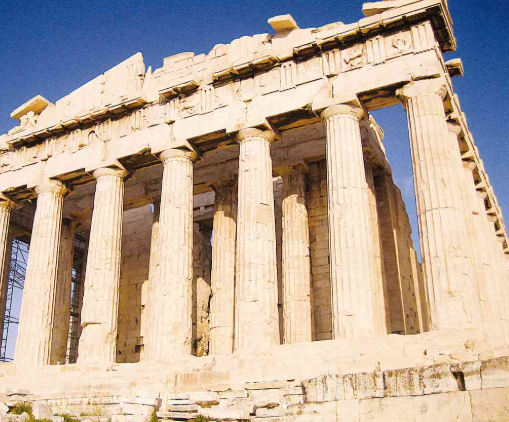
The Parthenon primarily utilizes the Doric order, known for its simplicity, heaviness, and strength. The columns lack bases, standing directly on a platform with simple, rounded capitals. The Doric order’s robustness and proportions imbue the building with a sense of solemnity, symbolizing strength and sacredness.
2. Ionic order
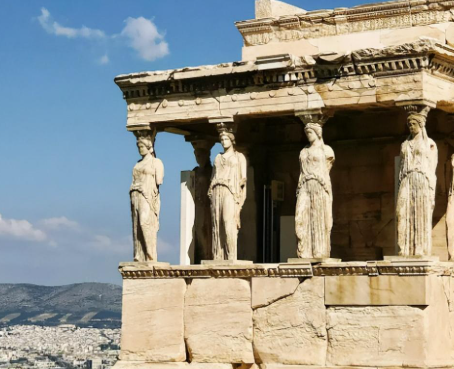
The Erechtheion uses the Ionic order, characterized by its slender, elegant columns and capitals adorned with spiral scrolls. This order is visually lighter, suitable for expressing refinement and agility, and demonstrates the Athenians’ high appreciation for proportion and ornamentation.
3. Corinthian
Some of the smaller, later buildings and monumental structures within the Acropolis use the Corinthian order, characterized by ornate capitals featuring foliage and floral patterns. The Corinthian order embodies the evolution of Greek architecture from simplicity to complexity, from practicality to ornamentation.
The Art of Proportion and Optical Illusion
The Acropolis of Athens is so impressive not only for its columns but also for its exquisite proportions. Ancient Greek architects, with a deep understanding of mathematics and visual perception, achieved visual balance through precise calculations.
1. Application of the Golden Ratio
Many Acropolis buildings adhere to a close-to-golden ratio (approximately 1:1.618), with strict proportions applied to column heights and spacing, as well as overall length and width. This makes the buildings appear harmonious and beautiful from every angle.
2. Subtle bends
Take the Parthenon as an example. The platform and columns are not completely straight, but slightly curved upwards, forming a slight curve. This design corrects the visual distortion and makes the building look more straight and stable from a distance.
3. Fine adjustment of column spacing and height
The ratio of column spacing to column height is carefully controlled to ensure visual balance. The Acropolis architects adjusted the thickness and density of the columns according to the observer’s perspective, giving the building a natural and harmonious overall appearance.
Building Materials and Construction Technology
1. Marble selection
The Acropolis of Athens is primarily constructed from Palestina marble, a material with a fine texture, a warm color, and ease of carving. Marble is not only beautiful but also weather-resistant, providing the building with a long lifespan.
2. Precision construction
The architects used wedge-shaped stones and mortar-free masonry techniques to ensure the structural stability. Each stone was precisely cut and polished, with seamless joints, ensuring the building’s integrity during earthquakes and weathering.
3. Carving and decoration
The capitals, cornices, and reliefs of the Acropolis buildings are meticulously carved. Depicting mythological stories and religious rituals, the reliefs not only decorate the buildings but also convey cultural messages. The integration of sculpture and architecture demonstrates the unity of function and aesthetics.
Modern Protection and Cultural Influence
1. Restoration and conservation
Modern science and technology have helped preserve the Acropolis. Weathering protection, earthquake-resistant reinforcement, and marble cleaning have ensured the building remains intact and visible millennia later. An international team is collaborating to protect the monument and ensure the preservation of this cultural heritage.
2. Cultural and tourism value
The Acropolis of Athens is not only an architectural wonder but also a must-see for tourists worldwide. It inspired Western architectural styles such as neoclassical architecture and modern public buildings. Its concepts of column style and proportion continue to be reflected in modern aesthetic design.
3. Significance of Architectural Education
The Acropolis is an excellent teaching material for learning about classical architecture, proportional aesthetics, and engineering skills. Architects, artists, and cultural researchers can all draw inspiration from it.
Summarize
The Acropolis of Athens is not only a religious and political center, but also an architectural textbook made of stone. With its columns, precise proportions and exquisite construction , it has become a representative of the beauty of classical architecture.
The Doric, Ionic, and Corinthian columns, each with their own unique characteristics, combined with the golden ratio and visual fine-tuning, make this building still awe-inspiring millennia later. From art, history, to engineering, the Acropolis of Athens showcases the wisdom and aesthetics of the ancient Greeks.
It tells us that architecture is not only a practical space, but also a comprehensive expression of culture, faith and mathematical beauty. Approaching the Acropolis, every column and every stone reflects the human pursuit of order and beauty.