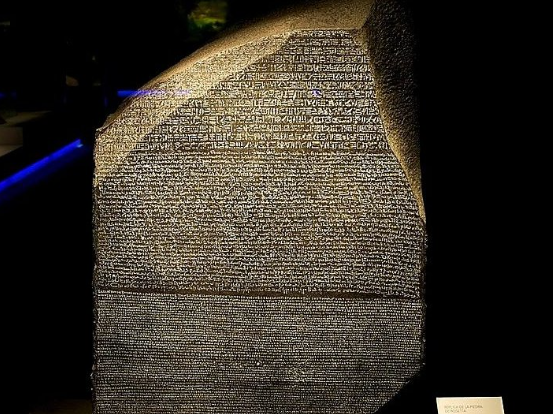
Even the slightest interest in ancient Egyptian civilization is undoubtedly familiar with the Rosetta Stone . This stone not only revolutionized the interpretation of ancient Egyptian hieroglyphics but also became a landmark in archaeology and linguistics.
From its discovery in Egypt in 1799 to the present day, the Rosetta Stone’s story spans over two centuries, captivating countless scientists, history enthusiasts, and tourists.
Today, we will use a relaxed spoken language to show you the civilization code behind this stone tablet and the new discoveries of modern research.
Discovery and historical background of the stele
In 1799, French expeditionary forces unearthed this black granite stele while building fortifications near the Egyptian town of Rosetta.
The stele is inscribed with three scripts : hieroglyphics, Civil Egyptian (commonly known as “cursive”), and ancient Greek.
Initially, the stele was simply collected as an ordinary antiquity, but scholars soon realized that these three scripts provided key clues to deciphering ancient Egyptian civilization.
In particular, ancient Greek, which was already readable at the time, allowed scientists to compare it with hieroglyphs, which was like finding the key to unlocking the treasure trove of ancient Egyptian language.
The meaning of the three languages
The three characters on the stele each have their own purpose:
Hieroglyphics
Were primarily used for religious and official texts and were complex and solemn in form.
Civil Egyptian
Is a simplified version of hieroglyphics, more suitable for everyday use.
Ancient Greek
At that time, Egypt was under Greek rule, and Ancient Greek was used to publish official announcements, so scientists can understand its content.
It is the combination of these three scripts that makes the Rosetta Stone the “Bible” for studying the ancient Egyptian language and a bridge connecting ancient civilization and modern academia.
Deciphered Legend
Deciphering the stele was not an overnight success.
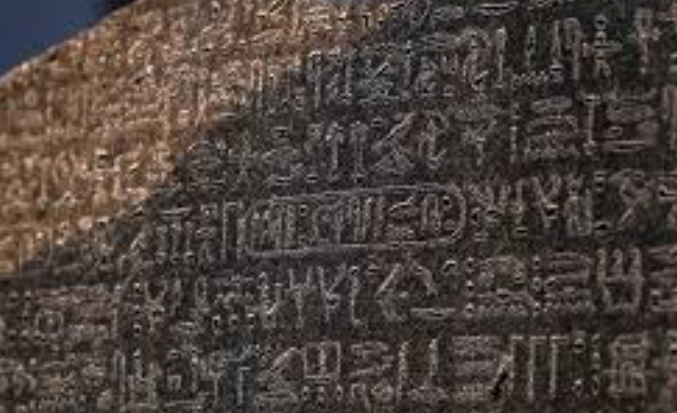
It was not until 1822 that French scholar Jean-François Champollion successfully deciphered the basic grammar and symbols of ancient Egyptian hieroglyphics by gradually comparing them with Greek hieroglyphics.
The process is full of drama:
He had to analyze the shapes and arrangements of hundreds and hundreds of symbols;
At the same time, we need to guess which symbols represent names of people, places or common words;
It is also important to distinguish whether the pictographic symbols are ideographic, phonetic or mixed.
Ultimately, Champollion successfully uncovered the ancient Egyptian language, revolutionizing archaeology, history, and linguistics.
From then on, humans could directly read the inscriptions on the pyramids and the murals in the pharaohs’ tombs, understanding Egyptian civilization thousands of years ago.
New progress in modern research
As technology advances, research on the Rosetta Stone continues to evolve.
In recent years, archaeologists and linguists have used digital scanning, 3D modeling, and high-precision imaging techniques to analyze the stone in greater detail.
New developments include:
Analysis of text wear:
Scientists used high-resolution imaging to discover subtle differences in the engraving methods of some texts on the stone tablet, which helped researchers infer the identity of the engraver and the characteristics of the era.
Color residue detection shows
that the stele may have been painted originally. Through chemical analysis, scholars have found residual pigments of hieroglyphs and Greek words, providing clues for studying the decorative style of ancient Egypt.
Studies of symbol evolution
Comparing the Rosetta Stone with other Egyptian texts have given scientists a more accurate understanding of how hieroglyphics evolved from classical forms to late civil script.
Digital restoration and interactive display
The museum uses 3D printing and augmented reality technology to allow the public to “touch” the stone tablet online and even try to decipher the hieroglyphics, greatly enhancing its educational and cultural communication value.
These new technologies have made the Rosetta Stone not just a static exhibit, but also an interactive tool for modern academic research and public education.
Cultural and educational value
The value of the Rosetta Stone goes far beyond academic research; it also has profound humanistic significance:
Of Civilizations
Monument connects ancient Egyptian civilization with the modern world, allowing people to understand human life, religious beliefs and social structures thousands of years ago.
Inspiration for language learning
It shows the process of language development and writing evolution, providing vivid cases for linguistics and cultural education.
Global Cultural Symbol
As one of the Louvre’s most important exhibits, the Rosetta Stone symbolizes the power of cultural exchange and the transmission of knowledge.
Today, in classrooms, museums, and science programs, the Rosetta Stone remains an indispensable teaching and interpretive resource.
The “stars” of the museum
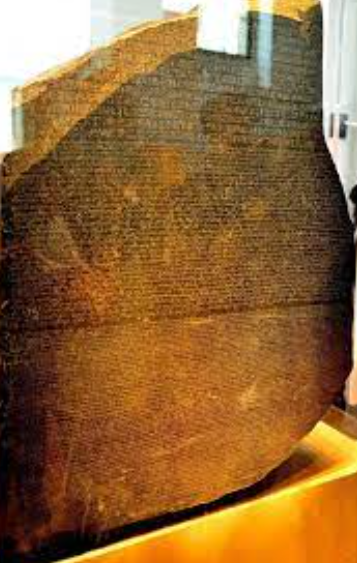
Now housed in the Louvre Museum in Paris , attracts thousands of visitors each year.
Many may come simply to see the stone, but when you stand before it and carefully examine the rows of densely packed text, you feel a sense of awe that transcends time and space:
Thousands of years ago, people used stone to record their lives, beliefs, and power, and today we can still understand them—a miracle that transcends language and time.
In order to help visitors better understand the stone tablets, museums usually equip them with explanatory signs, digital interactive screens, and even launch AR applications so that people can “restore” the text on the stone tablets and experience the fun of deciphering it.
Summary : The code of civilization in words
The Rosetta Stone tells us that history is never silent.
It communicates with us through stone, text, and symbols, allowing modern people to understand the civilization, wisdom, and aesthetics of ancient Egypt.
As technology and research continue to advance, the stone’s secrets are gradually being revealed.
Each new discovery deepens our understanding of ancient Egyptian civilization and makes the Rosetta Stone a cultural code that spans millennia .
Standing before the stele, you might imagine yourself as the scholar deciphering ancient civilizations, experiencing the joy of deciphering text.
More than just a stone, it serves as a bridge connecting past, present, and future, bearing witness to humanity’s pursuit of knowledge and reverence for civilization.