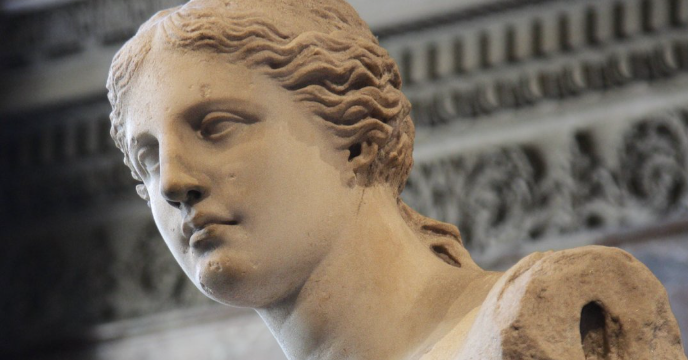
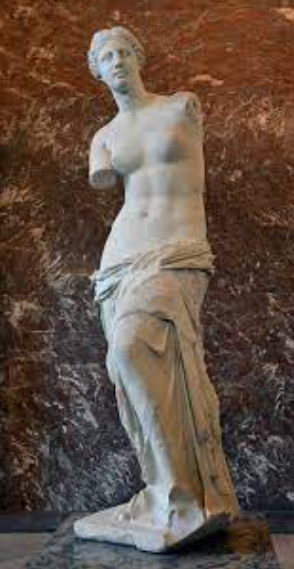
If you step into the Louvre, one statue is sure to captivate you: the Venus de Milo .
Her armless form doesn’t diminish her breathtaking beauty.
From her graceful posture to her exquisite lines, the Venus de Milo seems to silently tell a story spanning two thousand years.
Today, let us use a relaxed spoken language to explore the cultural value, historical stories and artistic secrets behind this statue.
“Discovery” in history
The Venus de Milo statue was discovered in 1820 on the Greek island of Milos , hence its name.
When archaeologists uncovered her amidst the ruins, her arms were long gone, leaving only the graceful curves and soft lines of her figure.
Some might wonder, “Without her arms, wouldn’t she be incomplete?”
But the truth is, it is precisely this loss of her arms that imbues her with a certain mystery , igniting endless imagination among viewers: what actions might she be performing? What props might she be holding? These have become the subject of much cultural interpretation.
It is worth mentioning that soon after its discovery, the Venus de Milo was taken to the Louvre in Paris and became the museum’s treasure.
From then on, she became not only a symbol of ancient Greek sculpture, but also a representative of Western art and culture.
Artistic Style and Body Aesthetics
The Venus de Milo dates from the 2nd century BC in ancient Greece and is a Hellenistic sculpture .
Sculptures from this period emphasized naturalism and human proportions , pursuing an idealized beauty of the human body.
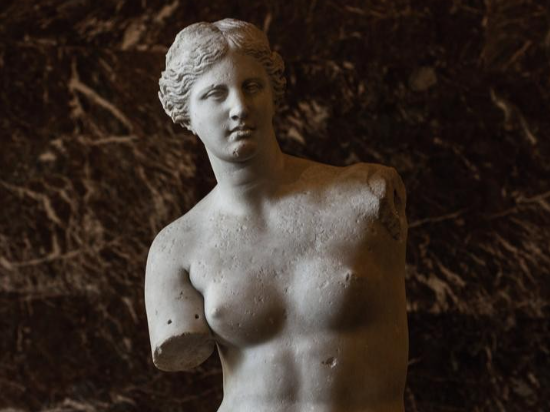
Look at the body curves of the Venus de Milo:
Slightly tilted shoulders
Soft chest lines
The waist is tightened and the hips are rounded.
These proportions are close to the golden ratio, presenting a harmonious and elegant visual effect .
Even more astonishing is that even with both arms missing, the statue still exudes a sense of movement , as if she might turn, stretch, or make some graceful gesture at any moment.
This not only demonstrates the sculptor’s precise grasp of human movement, but also allows us to appreciate the Greek artist’s ultimate pursuit of aesthetics.
Culture and symbolism
Venus de Milo is not only a symbol of beauty, but also carries profound cultural connotations:
The goddess of love and beauty
represents love and beauty in ancient Greek mythology and symbolizes the softness and charm of women.
Mystery and Imagination
The lack of arms makes her full of the unknown, and the audience can freely imagine her posture, movement or story.
Cultural Leap
The ruins of Milos Island to the display cases of the Louvre, her journey embodies the power of cultural communication – how an ancient sculpture influences modern aesthetics, artistic creation and cultural education.
The Venus de Milo teaches us that beauty is not merely complete in form, but rather an extension of the spirit .
Sometimes, imperfection itself is a kind of beauty that inspires our imagination and aesthetic emotions.
Influence and enlightenment to later generations
The Venus de Milo has had a profound influence on subsequent artists, designers, and cultural creators:
Renaissance and Modern Art
Her pose, proportions and graceful lines have become classic models for sculptors to imitate.
Advertising and popular culture
Her image has been used in movies, advertising, fashion design and other fields, becoming a symbol of female beauty.
In education and aesthetic research
Helping students understand the charm of classical aesthetics.
Venus de Milo tells us that the value of art lies not only in its material existence, but also in its cultural transmission, ideological inspiration and aesthetic resonance .
Why is she still charming?
Many people ask: Why is Venus de Milo still fascinating after two thousand years?
Proportion and Lines : Ancient Greek sculptures pursued idealized human proportions to create a timeless aesthetic.
Mystery : The missing arms create a sense of participation and imagination among the audience.
Cultural symbol : She is not only a statue, but also a collection of love, beauty, myth and history.
Humanistic feelings : Every time you watch it, you can feel the warmth of history and the ingenuity of the artist.
She made us understand that beauty is a power that transcends time , and even after thousands of years , it can still touch people’s hearts.
Venus de Milo and Modern Life
In modern life, we may no longer use pottery or statues to express faith or aesthetics, but the lessons learned from the Venus de Milo still apply:
Appreciate imperfection
Perfection is not necessarily complete, and lack can also create unique charm.
Experiencing cultures across time and space
An ancient work of art can help us understand the lives, aesthetics, and thoughts of the past.
Aesthetics and Imagination
Art inspires our creativity and sensitivity, and adds depth to our lives.
This is why museums and art exhibitions continue to be so captivating – they showcase not just objects but history, culture, and the human spirit .
Summary : The mysterious beauty of losing arms
Despite losing her arms, the Venus de Milo has captured the world’s imagination.
She is not only a pinnacle of sculpture but also a cultural icon.
From the ruins of Milos to the Louvre’s showcase, she has completed a cultural journey spanning millennia .
She tells us that the value of art lies not in perfection, but in its ability to touch hearts, inspire thought, and transmit culture.
Despite losing both arms, she demonstrated her mysterious beauty and eternal charm to the world through her silent gesture .
Every time you gaze at the Venus de Milo, it’s like having a conversation with artists from two thousand years ago, feeling their understanding of beauty and humanity, as well as the cultural wealth that history has bestowed upon us.